From planning and commissioning to daily operations and scaling, RDA delivers the intelligence needed to reduce energy costs, unlock capacity, mitigate operational risk, and accelerate decisions across next-generation AI infrastructure.
Digital Twin is the intelligence engine behind Red Dot AI. By continuously integrating live data from BMS, DCIM, sensors, etc, it creates a real-time virtual replica of your data centre, and builds a living model of your infrastructure. This enables predictive simulation, workload-aware optimization, liquid cooling management, and AI agent orchestration, helping operators optimize capacity, efficiency, and resilience in real time.
Digital Twin is built on a five-tier cognitive digital twin model. Each tier adds a layer of intelligence, from geometric spatial awareness at the foundation to fully autonomous operation at the top. Enterprise partners can deploy at any tier and progress upwards as operational maturity grows.
Tier 05
From modelling to updating, every step in the digital twin lifecycle is automated. The system self-calibrates against real-world operational data continuously.
Tier 04
Combined with AI, the platform performs control optimisation and recommends specific, ranked operational policies for cooling, power, and maintenance decisions.
Tier 03
What-if analysis and forward simulation. Operators can model operational scenarios and validate decisions inside the digital environment before implementing them.
Tier 02
Connected to live sensors for real-time system state visualisation across cooling, power, and rack infrastructure. Includes AI-powered anomaly detection and alerting.
Tier 01
The foundational spatial layer. A geometric model of the physical data centre environment, enabling accurate spatial positioning and infrastructure layout representation.
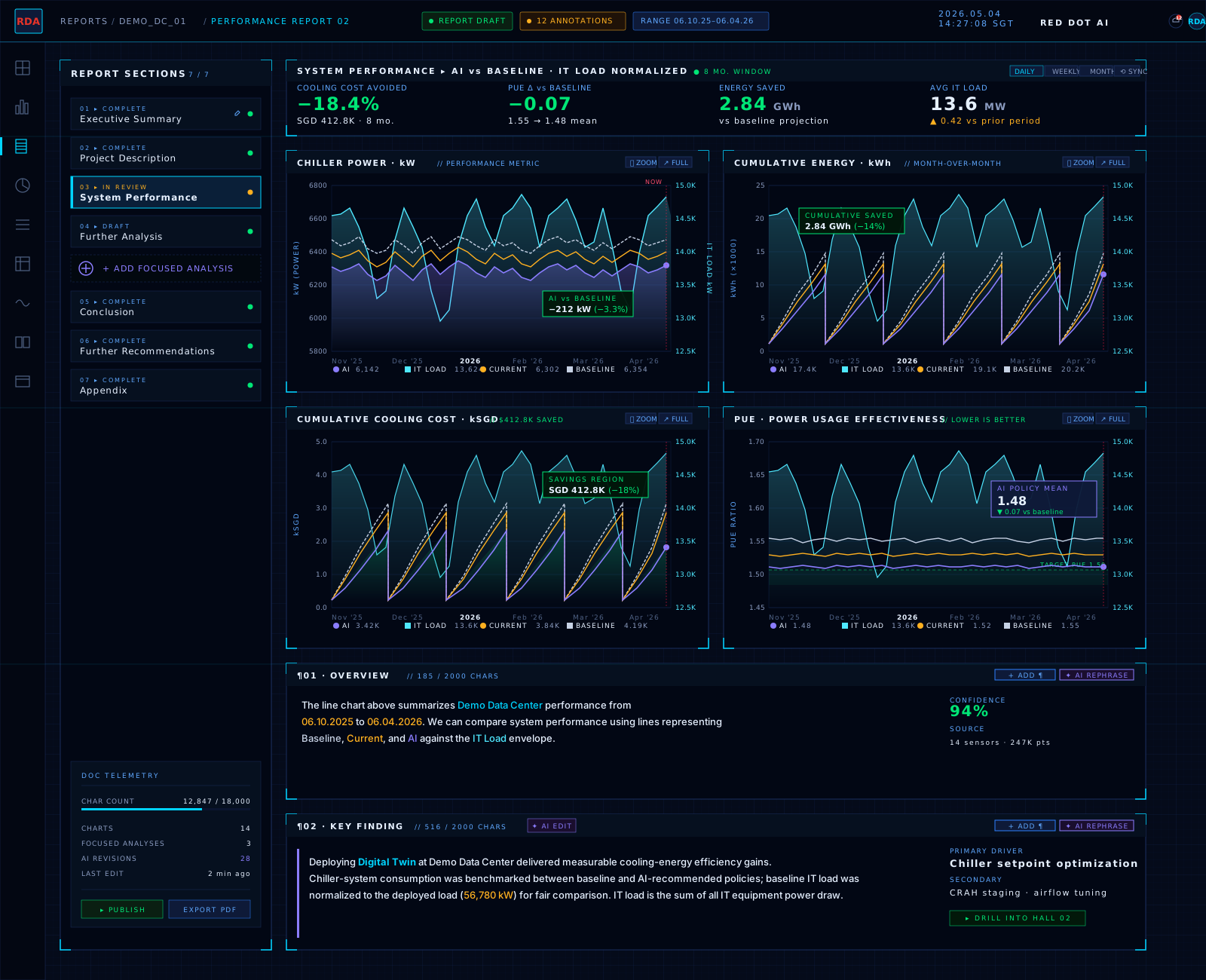
Turn every megawatt into competitive advantage. RDA continuously optimizes cooling, power, and facility systems using physics-informed AI, reducing energy waste, improving PUE, and unlocking hidden infrastructure capacity without compromising operational resilience.
Business Impact
AI-driven control and sequencing of chillers, cooling towers, and pumps to minimise energy consumption while maintaining thermal stability.
Optimisation of airflow, temperature setpoints, and load distribution within data halls to reduce overcooling and improve cooling efficiency.
Holistic optimisation of Power and Water Usage Effectiveness through coordinated control of cooling, power, and water systems.
Simulate cooling strategies, setpoints, and load scenarios to identify the most energy-efficient operating conditions before deployment.
Detect inefficiencies, equipment degradation, or abnormal energy patterns early — enabling proactive intervention.
Fine-tune system performance in real time to reduce energy consumption, lower operational costs, and improve sustainability metrics.
Provide operators with actionable insights and automated recommendations under dynamic load and environmental conditions.
Simulate decisions and actions before damage in production. RDA’s digital twin simulates thermal, compute, power, and operational scenarios in real time, allowing teams to validate changes, optimize configurations, and mitigate risk before deployment.
Business Impact

Simulate IT load, power demand, and cooling scalability across time horizons.
Optimise server and rack placement based on power, cooling, and space constraints.
CFD-based airflow and temperature distribution analysis to identify hotspots and inefficiencies.
Dynamic scenario exploration across operational and design variables before commitment.
Validate new builds or upgrades against performance, redundancy, and efficiency targets.
Benchmark multiple upgrade strategies side-by-side to identify the most cost-effective and impactful path.
Forecast future IT and infrastructure requirements accurately to prevent under- or over-provisioning.
Balance power usage, cooling efficiency, and physical constraints when placing IT loads.
Identify airflow inefficiencies and thermal risks before deployment — reduce hotspots and improve reliability.
Ensure new designs meet performance, resilience, and energy benchmarks before implementation.
Compare upgrade strategies side-by-side to determine the best ROI and operational impact.
Introducing Liquid Cooling Intelligence
Optimize liquid cooling infrastructure with confidence. RDA monitors and predicts thermal behavior across CDUs, cooling loops, racks, and facility systems, enabling safe, efficient, and scalable liquid cooling operations for high-density AI workloads.
Business Impact
Detect early signs of flow instability, pressure drops, leakage risks, or thermal hotspots before they impact IT performance.
Continuously optimise pump speeds, valve positions, and flow distribution to maintain ideal cooling while minimising energy.
High-fidelity simulations of coolant behaviour under varying loads — precise tuning of temperature and flow across racks and loops.
Precise mapping of liquid cooling loops, rack layouts, CDU placement, and pipe routing.
Simulate coolant flow, heat transfer, pressure distribution, and temperature gradients across the system.
Machine learning trained on historical flow, pressure, and thermal data to predict anomalies and optimise performance.
Analyse pump capacity, flow distribution, and system resistance to ensure balanced and efficient cooling delivery.
Introducing Agent AI Operations
Move from tedious and complex operations to intelligent AI infrastructure. RDA deploys AI agents that understand operational context, predict anomalies, recommend actions, and automate workflows, empowering operators to manage increasingly complex AI infrastructure at scale.
Business Impact
The Challenge
Facility data cannot leave the site. Experts must travel physically for every assignment. Institutional knowledge walks out the door when they do.
The Challenge
Specialist teams are spread thin and rotated between sites. Junior operators are left facing high-stakes decisions without adequate support.
How Agent AI Solves It
Pre-trained expert agents for data centre domains: Data Hall Designer, Facility Systems Monitoring, Equipment RCA Analyst, Operations Management Advisor, and Operations Analyst and Planner.
Pre-built and customisable one-click analysis flows for daily analysis and insights. AI-assisted ad-hoc analysis and reporting with on-premises workflow formulation.
Examine and analyse live facility data. Investigate hypotheses with conclusive evidence. Compile and summarise findings for stakeholder reporting automatically.
Automatically generate operational reports, compliance checks, and audit trails with minimal manual effort.
Rapidly identify underlying causes of incidents using AI-driven correlation across systems and historical data.
What Your Team Gets
Always ready and available for every shift. Continuous analysis without dependency on specialist schedules.
Continuous build-up of institutional, site, and domain knowledge. Learns from every user and team interaction. Enhances onboarding for new operators joining the facility.
Handles heavy lifting in data collation, analysis, and reporting. Operators focus on decisions and execution. Configurable for site-specific requirements and operational context.