RDA at GSTCE 2026: Advancing the Momentum on Space Data Centres
Singapore, 14 May 2026 — Red Dot Analytics (RDA) was pleased to participate in the Global Space Technology Convention & Exhibition 2026 (GSTCE 2026), held from 13–14 May 2026 at Marina Bay Sands, Singapore.
Centred around the theme “Commercialising Space: Driving Economic Value Across Industries”, GSTCE 2026 brought together leaders from across the space, technology, research, investment, and policy ecosystems to explore how space-driven innovation can unlock new economic opportunities and strategic capabilities for the future.
As part of the conference programme, RDA’s Chief Scientist, Yonggang Wen, delivered a presentation titled “From Lab to Launch: Partnering to Build Space Data Centres in Singapore & Beyond”.
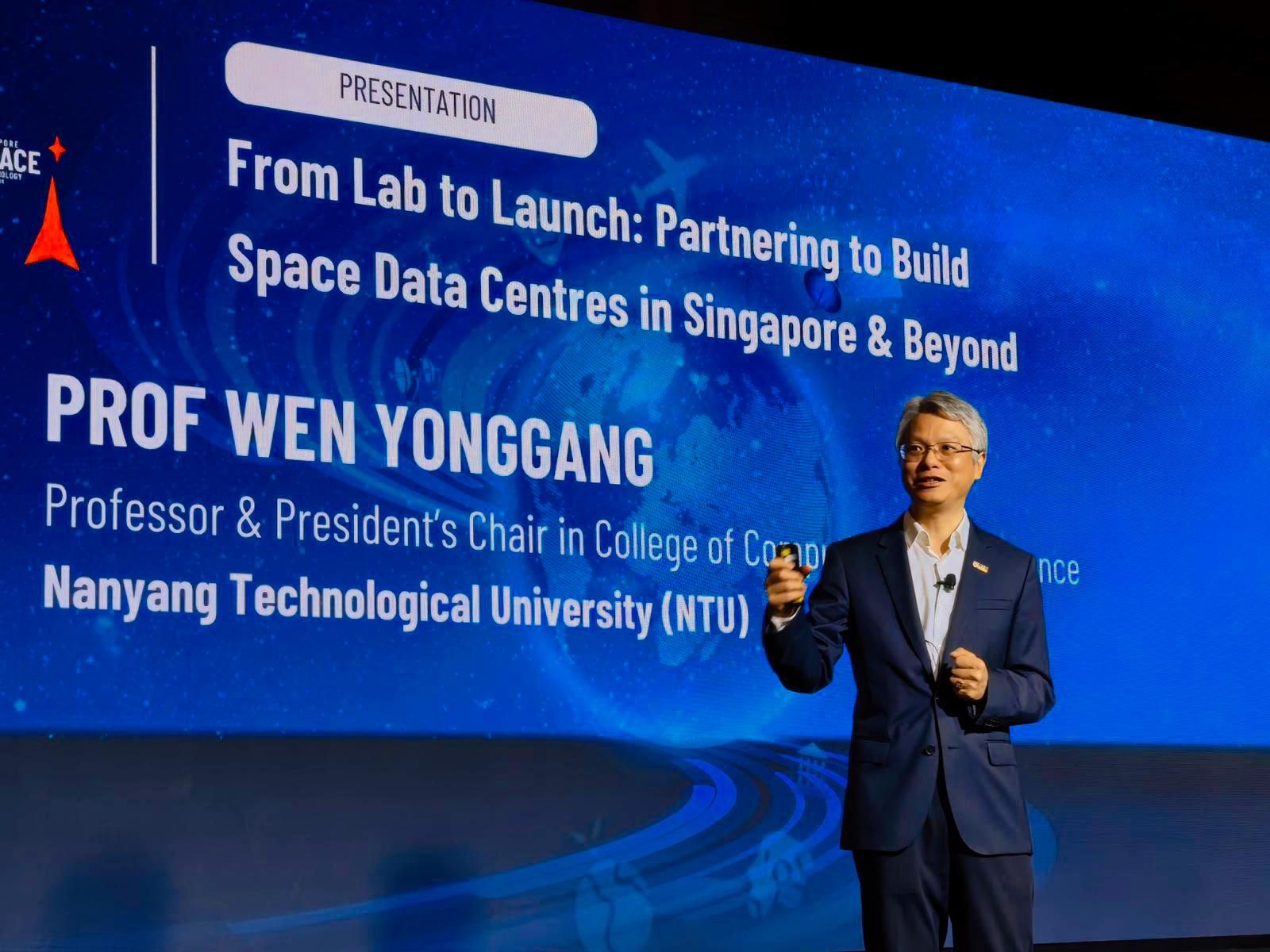
The presentation explored how the rapid acceleration of AI is fundamentally reshaping global infrastructure demands and intensifying existing constraints surrounding power availability, cooling efficiency, land scarcity, operational resilience, and long-term sustainability.
Prof Wen highlighted that the next era of compute infrastructure may require the industry to think beyond conventional terrestrial limitations. As AI workloads continue to scale exponentially, the future of digital infrastructure will increasingly depend on how sustainably and intelligently compute capacity can be expanded.
Against this backdrop, space data centres are emerging as a growing area of strategic interest, driven by the potential advantages of abundant solar energy, access to deep-space radiative cooling, and the opportunity to rethink infrastructure deployment models beyond Earth-bound resource limitations.
The session also examined why Singapore is uniquely positioned to contribute to this emerging frontier.
As a globally connected digital hub with strong capabilities across advanced manufacturing, semiconductor technologies, AI research, satellite communications, sustainability innovation, and digital infrastructure operations, Singapore possesses many of the foundational building blocks needed to support future space-enabled compute ecosystems.
Prof Wen also emphasised the importance of long-term ecosystem development and cross-sector collaboration in turning research concepts into practical industry pathways.
The presentation called for stronger partnerships across academia, industry, government agencies, infrastructure operators, technology providers, and investors to collectively shape the standards, technologies, operating models, and commercial frameworks required for the next generation of sustainable compute infrastructure.
Rather than viewing space data centres purely as a distant technological concept, the session encouraged stakeholders to begin engaging early in the broader discussions surrounding infrastructure resilience, sovereign compute capabilities, sustainability, and future digital competitiveness.
RDA was encouraged by the strong engagement and thoughtful discussions generated throughout the event. GSTCE 2026 provided a valuable platform to exchange perspectives with ecosystem partners, researchers, policymakers, and industry leaders on the future of sustainable and intelligent infrastructure.
As AI adoption continues to accelerate globally, the future of compute will not be defined by scale alone, but by how intelligently infrastructure can evolve to meet the demands of the next digital era.
RDA remains committed to advancing innovation across AI infrastructure, digital twin technologies, and next-generation operational intelligence, while contributing to industry conversations that help shape the future of resilient and sustainable digital infrastructure.
We thank the organisers, partners, speakers, and participants of GSTCE 2026 for the opportunity to be part of this important dialogue.
The conversations have started. Now, the work continues.